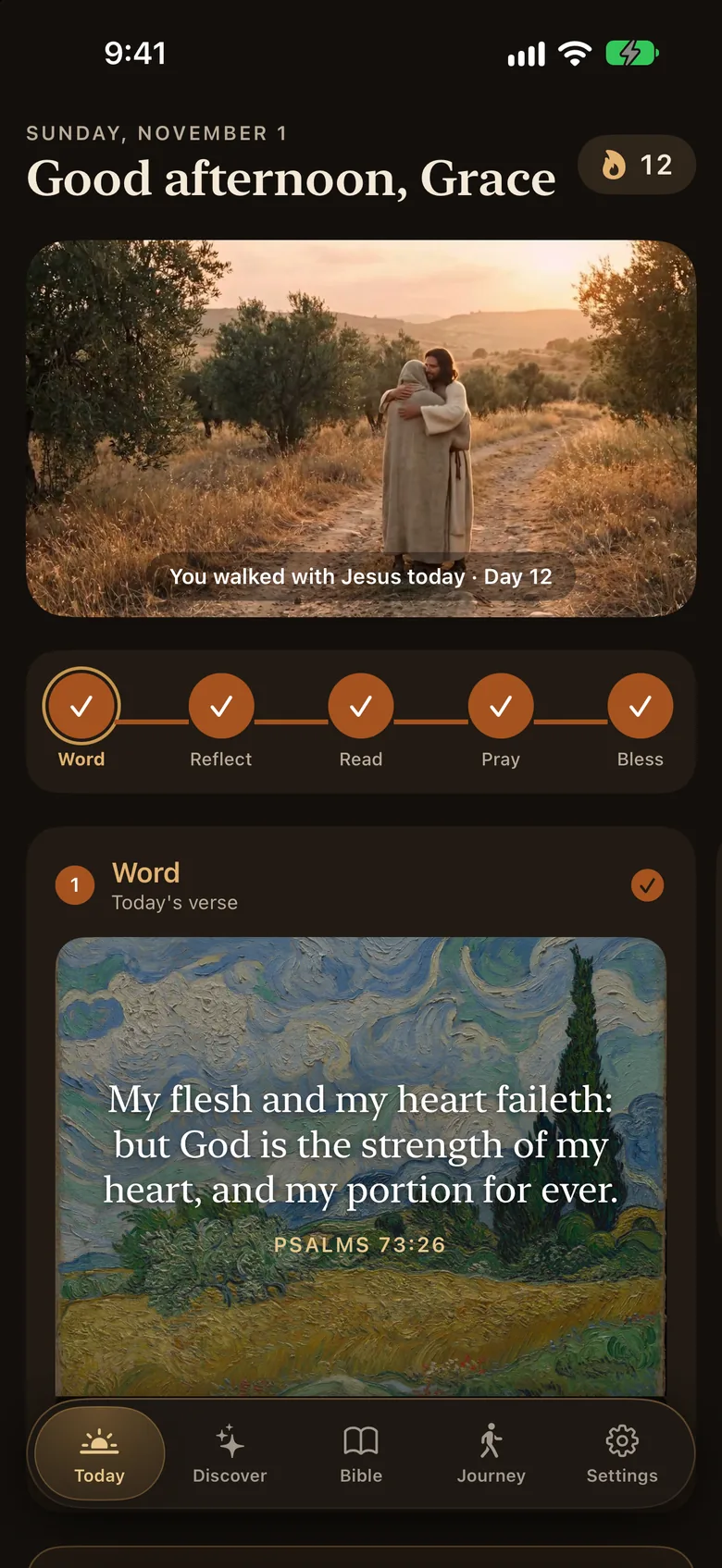
The King James Version (KJV) and the World English Bible (WEB) are the two English translations in Lamp. Both are public domain, which means anyone can read, print, copy and share them without paying or asking permission (with one exception for the KJV in the United Kingdom, covered below). They come from the same family of English Bibles, yet they read very differently.
The King James Version
The King James Version was translated by a team of scholars in England under King James I and first published in 1611. Many common English sayings come from it, and many people still know Psalm 23 or the Lord's Prayer by heart in its words.
The KJV most people read today, including the one in Lamp, is the 1769 edition. It kept the 1611 translation but standardized the spelling and punctuation, which had varied a lot in earlier printings.
The KJV is public domain in most of the world. In the United Kingdom, the Crown still holds rights to it, so publishers there need permission to print it.
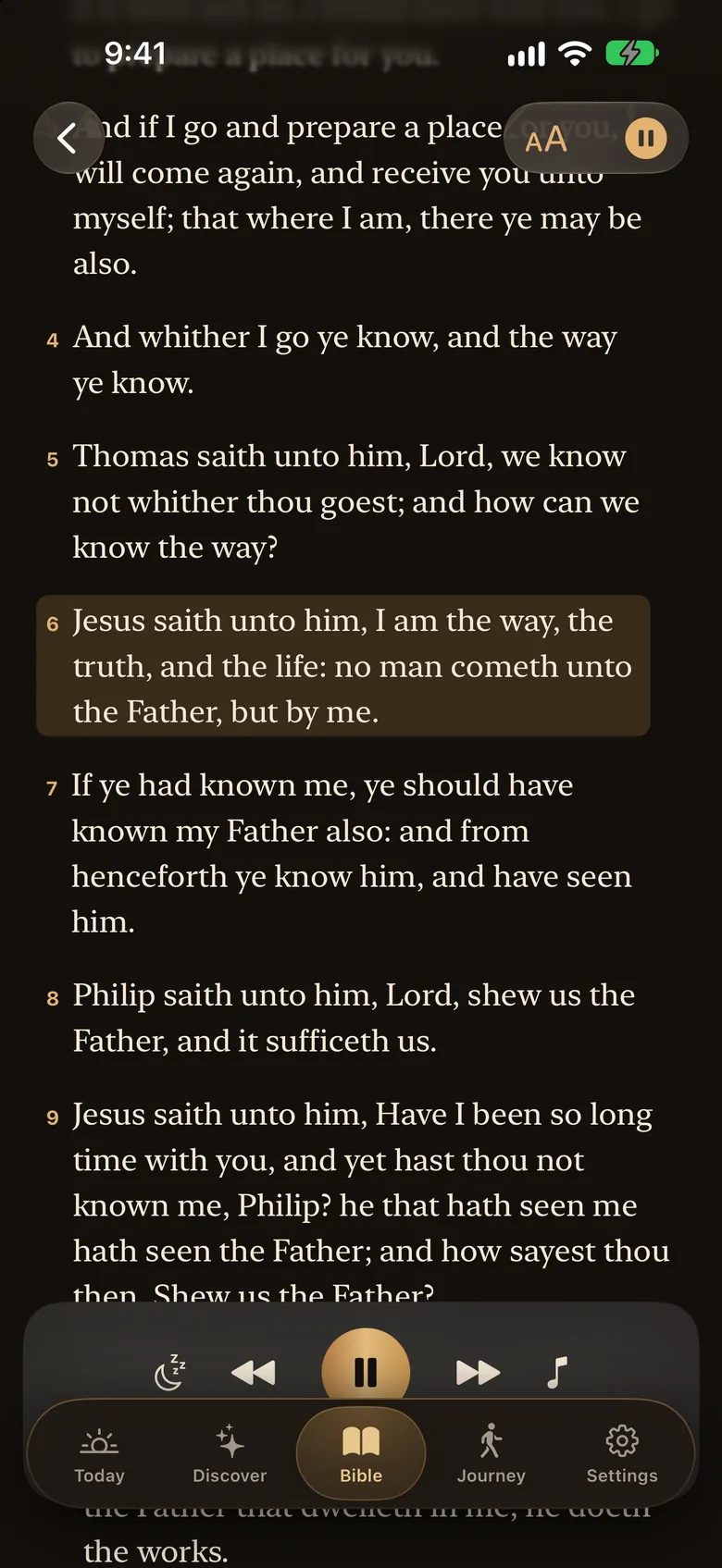
It uses the English of its time: "thee" and "thou," verbs that end in "-eth," and some words whose meanings have changed since.
The World English Bible
The World English Bible is a modern update of the American Standard Version of 1901. The ASV was itself a revision in the King James tradition, so the WEB stands in the same line. Its translators put it in the public domain on purpose, so it can be copied and shared freely with no copyright notice needed.
The WEB uses everyday modern English. "You" replaces "thee" and "thou," and it uses contractions like "don't." The edition in Lamp writes "the LORD" for God's name in the Old Testament, as the KJV usually does.
Four verses side by side
The best way to see the difference is to read the same verse in both. Each pair below shows the KJV first, then the WEB.
Philippians 4:6
Be careful for nothing; but in every thing by prayer and supplication with thanksgiving let your requests be made known unto God.
In nothing be anxious, but in everything, by prayer and petition with thanksgiving, let your requests be made known to God.
In 1611, "careful" meant full of care, or anxious. So "be careful for nothing" means don't be anxious about anything, which is how the WEB puts it. A reader today could easily take the KJV to mean "don't be cautious," which isn't what Paul meant.
Matthew 6:34
Take therefore no thought for the morrow: for the morrow shall take thought for the things of itself. Sufficient unto the day is the evil thereof.
Therefore don’t be anxious for tomorrow, for tomorrow will be anxious for itself. Each day’s own evil is sufficient.
"Take no thought" was the KJV's way of saying "don't worry." Jesus isn't telling His listeners not to plan. He's telling them not to be anxious about tomorrow. The WEB makes that plain. The KJV's "Sufficient unto the day is the evil thereof" became a well-known English saying.
1 Corinthians 13:4
Charity suffereth long, and is kind; charity envieth not; charity vaunteth not itself, is not puffed up,
Love is patient and is kind. Love doesn’t envy. Love doesn’t brag, is not proud,
The KJV translators used "charity" in this chapter, from the Latin word for love. Today "charity" usually means giving to the poor, so the WEB says "love." Both translate the same Greek word.
Psalm 23:1
The LORD is my shepherd; I shall not want.
The LORD is my shepherd; I shall lack nothing.
"I shall not want" doesn't mean "I won't desire anything." In older English, "want" meant to lack. The WEB's "I shall lack nothing" says the same thing in today's words, while the KJV line is the one many people learned as children.
Other KJV words that have changed
A few more KJV words have shifted in meaning since 1611:
- "Suffer" often means allow. In "Suffer the little children to come unto me" (Mark 10:14), Jesus is telling His disciples to let the children come. The WEB says "Allow."
- "Prevent" meant to go before. In 1 Thessalonians 4:15, "shall not prevent them which are asleep" means won't go ahead of them. The WEB says "precede."
- "Conversation" meant your whole way of life. "Let your conversation be without covetousness" (Hebrews 13:5) is about how you live, and talk is only part of that.
- "Let" could mean hinder, almost the opposite of its meaning today. That's why 2 Thessalonians 2:7 reads "he who now letteth will let."
Readers in the 1600s knew these words in their old senses. Knowing those meanings makes the KJV much easier to follow today.
Which one should you read?
Neither is the "right" translation, and we don't claim one is more accurate than the other. They make different trade-offs.
The KJV is good for:
- reading passages you may already know by heart, in the words you learned them
- the rhythm of its language, which many people find beautiful to read aloud and easy to memorize
- reading alongside older hymns, books and sermons that quote it
The WEB is good for:
- understanding a verse on first reading, without old meanings getting in the way
- reading longer passages, such as a whole chapter or book, at a steady pace
- people who are new to the Bible or whose first language isn't English
Many people use both. If a KJV verse is hard to follow, read the same verse in the WEB, and you'll usually see what it means. If a WEB verse feels flat to you, the KJV may give it back some of its weight.
Reading both in Lamp
Lamp has both translations, and you can switch between them at any time in Settings. The whole Bible is in the app in both, so it works offline. The verses on our topic pages, such as Bible verses about anxiety, can also be read in either one.
Lamp uses public-domain translations so the full text can live in the app and be shared freely. That's also why it doesn't include the NIV, ESV or other copyrighted modern versions.
If you're building a daily habit, our guide on how to read the Bible every day has some simple ways to begin.
Questions people ask
What is the World English Bible?
The World English Bible (WEB) is a modern English update of the American Standard Version of 1901. It's in the public domain, so anyone can copy, print and share it freely. It uses everyday English, with "you" in place of "thee" and "thou."
Is the World English Bible a good translation?
The WEB updates the American Standard Version, which comes from the same tradition as the King James Version. Like every translation, it makes choices about wording. It reads clearly, and it pairs well with the KJV when you want to check what an older word means. If you're studying a passage closely, comparing a few translations is always a good idea.
Is the King James Version public domain?
Yes, in most of the world. In the United Kingdom, the Crown still holds rights to the King James Version, so publishers there need permission to print it. The text most people read today is the 1769 edition, which standardized the spelling and punctuation of the 1611 translation.
Why does the KJV say "thee" and "thou"?
It was written in the English of the early 1600s. Back then, "thee" and "thou" were the singular forms of "you," and "ye" and "you" were plural. So the KJV shows whether one person or a group is being spoken to. Modern translations like the WEB use "you" for both.